












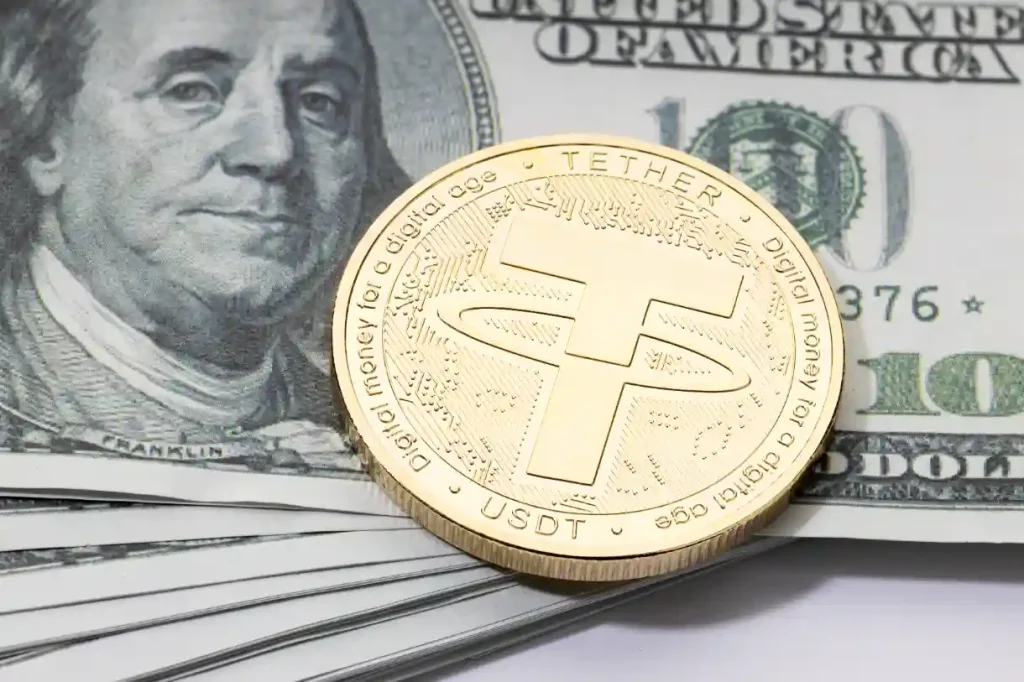
USDT Tether coin lies on top of a stack of $100 notes
Ad
Tether has announced the launch of USA₮, a U.S. dollar-backed stablecoin described as federally regulated and issued under a U.S.-based framework. The announcement marks a notable shift in Tether’s strategy as the company moves to establish a compliant, domestically issued stablecoin.
The new product is positioned as a fully regulated alternative to existing offshore stablecoin structures. Essentially, it signals an effort to operate directly within the evolving U.S. digital asset framework.
Tether Introduces USA₮
According to official information released by Tether, USA₮ is designed as a dollar-backed stablecoin issued under federal regulatory oversight, with reserves intended to fully back the circulating supply.
Additionally, the company describes the product as “Made in America,” emphasizing domestic issuance and compliance with U.S. financial regulations.
The launch follows increasing regulatory clarity around stablecoins in the United States. Particularly as lawmakers and regulators push for clear rules governing reserve backing, disclosures, and issuer accountability.
Tether’s yet to disclose all technical and operational details publicly. However, the official announcement frames USA₮ as a compliant on-chain dollar designed for institutional use cases and regulated financial integrations.
What This Could Mean for Crypto
The introduction of a federally regulated stablecoin by one of the largest players in the crypto market could have wide-reaching implications.
Moreover, stablecoins already serve as critical infrastructure for trading, payments, and on-chain liquidity. Therefore, clearer regulatory alignment may accelerate institutional participation.
A compliant U.S.-issued stablecoin could lower barriers for banks, payment providers, and regulated financial institutions that avoided crypto exposure in the past due to legal uncertainty.
This may also influence how regulators view the role of stablecoins in the broader financial system. Indeed, it might shift the narrative from risk mitigation toward structured integration.
Lastly, the launch of USA₮ highlights a maturing phase for crypto markets. Rather than operating outside traditional systems, major issuers are increasingly building products that fit within regulatory frameworks.
If successful, this approach could shape the next stage of crypto adoption, where compliance and scale are able to coexist.
More Must-Reads:
How do you rate this article?
Subscribe to our YouTube channel for crypto market insights and educational videos.






Join our Socials
Briefly, clearly and without noise – get the most important crypto news and market insights first.

Most Read Today
1
Chainlink’s 499% Social Volume Spike: Why Attention is Outpacing Price
2Cardano (ADA) Price Analysis: Quiet Accumulation as Technical Signals Begin to Strengthen
3Digital Silver’s Silent Strength: Litecoin (LTC) Fundamental and Technical Dive
4Mantle’s $1B Milestone: Why MNT is the Next Layer 2 Powerhouse to Watch
5The Pi Day Pivot: Can Polkadot’s Massive Supply Cut Fuel a DOT Breakout?
Latest







8
Also read
Similar stories you might like.

Blockchain
Wells Fargo Files ‘WFUSD’ Trademark for Crypto and Payment Services
Ana | 2026-03-11

Market
Exclusive: Crypto Trader Josh Rager Says Bitcoin’s 4-Year Cycle “Isn’t What It Used To Be”
Sead | 2026-03-11
Altcoins
Tether Freezes $4.2B in USDT, Here’s Why
Rokas | 2026-02-28

Altcoins
Crypto Whale Transfers Spike Ahead of Clarity Act Decision; Here’s Why
Ana | 2026-02-27

Blockchain
This Deal Pushes USDT Beyond Exchanges
Patrick | 2026-02-26

Industry
Regulator Drafts GENIUS Act Implementation Proposal, Seeks Public Comment
Ana | 2026-02-26

Bitcoin
The “Jane Street 10 AM” Narrative Meets a $68,000 Bitcoin Rally
Patrick | 2026-02-25

Industry
The First GENIUS Act ETF Is Here – And It’s Built for Stablecoins
Patrick | 2026-02-19
Industry
Circle Says Stablecoin Regulation Has Reached an Inflection Point
Patrick | 2026-02-17
Defi
White House Urges Stablecoin Deal, Sets the Deadline as Debate Continues
Ana | 2026-02-11