









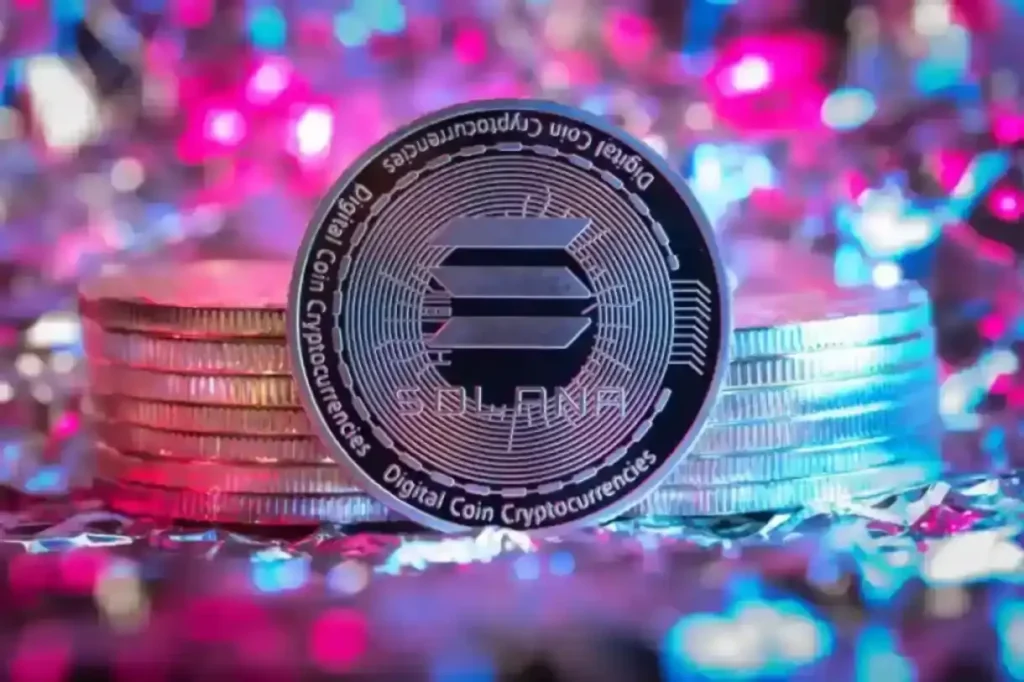
A Solana cryptocurrency coin stands upright against a stack of coins amidst vibrant, colorful bokeh. Source: TechGaged / Shutterstock.
Solana Pushes Toward Lower Inflation — But at What Cost?
In Brief
- • SIMD-0550 would reduce SOL inflation and supply growth faster.
- • Lower rewards could pressure smaller validators.
- • Technical indicators suggest selling momentum may be easing.

Solana is pursuing one of the most consequential tokenomics transformations in its history — and the market is currently too distracted by price pain to notice.
SIMD-0550, the proposal gaining serious traction in Solana’s validator community, aims to make the network’s supply schedule meaningfully leaner by front-loading the move to low inflation while keeping the same long-term target.
The upside is reduced dilution and lower structural sell pressure. The risk is validator strain and potential centralisation if rewards fall too quickly.
Latest Stories
Bitcoin Hits the Brakes, ZEC Hits the Gas

MetaMask Unleashes AI Agents Across DeFi Networks

This Could Be the Upgrade That Saves Zcash’s Credibility
The question is whether the market is confusing cyclical weakness with structural deterioration — because the two require very different responses.
What SIMD-0550 Actually Does
Solana’s current issuance schedule reduces inflation gradually toward a long-run target of 1.5%, but the pace has frustrated holders who watch validator rewards dilute their exposure across a prolonged timeline.
SIMD-0550 accelerates that journey — front-loading the compression toward the terminal rate rather than spreading it across years of slow reduction.
The immediate benefit is structural: less SOL entering circulation per epoch means less reflexive sell pressure from validators liquidating rewards to cover operational costs.
Over time, a leaner supply schedule combined with SIMD-547’s proposed resource-based fee burn — which co-founder Anatoly Yakovenko has publicly supported — creates a compounding deflationary effect that the current price has not begun to price in.
The risk is equally real. If validator rewards fall too quickly, smaller and mid-tier validators face margin compression that pushes them offline.
Thereby concentrating stake among the largest operators and introducing the centralisation pressure that Solana’s decentralisation roadmap was designed to avoid.
How validators vote, and whether the network can balance tighter tokenomics with sustainable staking economics, will determine whether SIMD-0550 becomes a lasting positive for SOL or a governance friction event that delays the re-rating.
Solana is redesigning its economic engine while the car is moving. The destination looks better. The road right now does not.
What the Weekly Charts Are Showing
The TradingView weekly charts generated at 09:11–09:13 UTC on June 9, 2026 present a technical picture that is simultaneously deeply bearish on the surface and quietly constructive underneath.
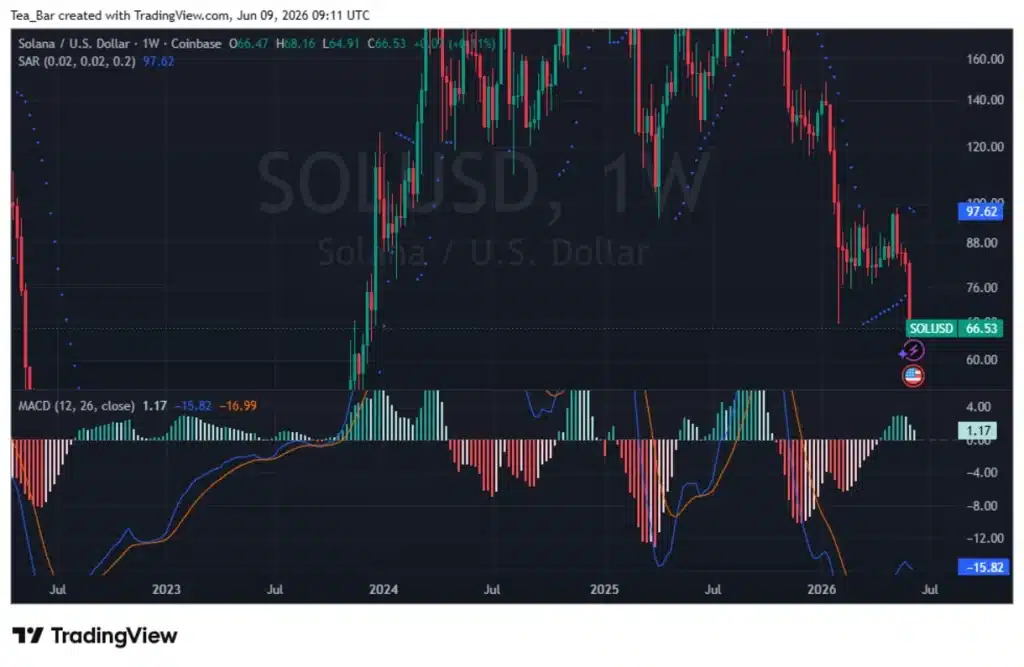
On SOL/USD (Coinbase), price sits at $66.53 with the Parabolic SAR overhead at $97.62 — confirming the weekly downtrend is structurally intact.
The MACD, however, delivers a more important signal: the histogram has turned positive at 1.17, crossing above zero for the first time after weeks of deeply negative readings, while the MACD line at −15.82 begins curling toward the signal line at −16.99.
A histogram turning positive from deeply oversold territory is not a reversal confirmation — but it is the earliest possible technical footprint of momentum exhaustion.
The SOL/BTC weekly chart (Coinbase) reinforces the case structurally. At ₿0.0010583, price is pressing against the Bollinger lower band at ₿0.0010181 — a level that has acted as major support on this pair only twice in three years:
At the 2022 bear market floor and during the pre-breakout accumulation of late 2023. Both preceded significant recoveries.
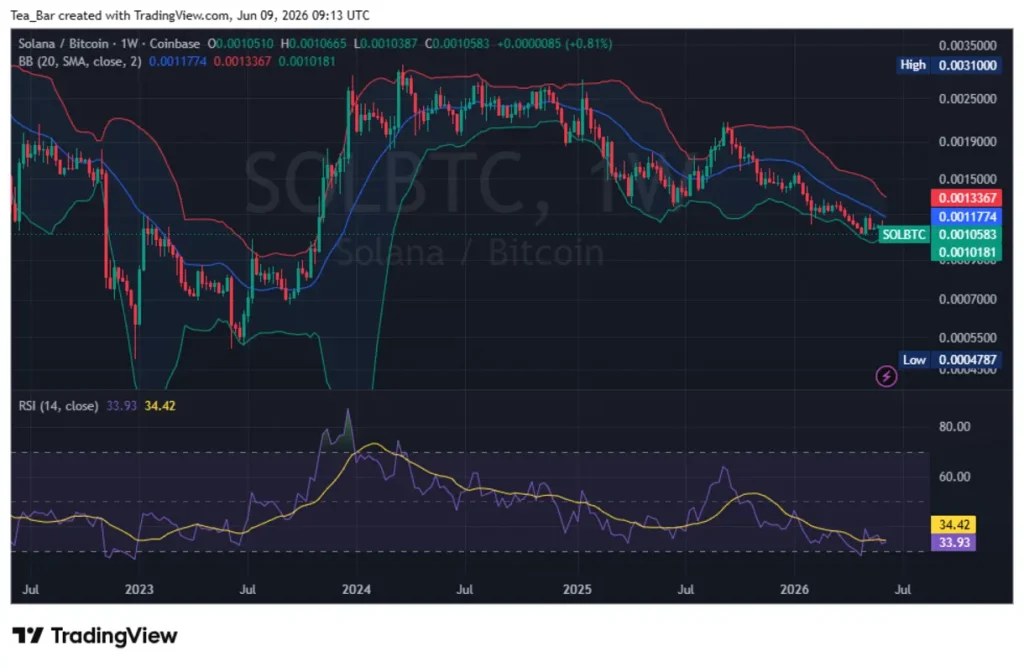
The RSI at 33.93 approaching the signal line at 34.42 is the technical configuration that patient buyers build positions around.
The Cost and the Reward
The cost of SIMD-0550 is validator friction, governance uncertainty, and the risk of centralisation if the reward compression moves faster than the ecosystem can absorb.
The reward — if the proposal passes and the deflationary mechanics engage alongside the fee burn framework — is a supply dynamic that fundamentally reprices what SOL should be worth during the next period of high network demand.
Solana’s application revenue recovered 16% month-over-month in May. BlackRock, Visa, and SoFi are building on its rails. At $66.53, the market is pricing the cost.
The validator vote has not yet been cast. And somewhere in that outcome lies the difference between SOL at $66 being the worst price to hold — or the last time anyone gets to buy it here.
Disclaimer:
This article is for informational purposes only and does not constitute financial, investment, or trading advice. The views expressed are based on publicly available data, market observations, and the author’s interpretation at the time of writing. Cryptocurrency markets are highly volatile and unpredictable, and past performance or current technical setups do not guarantee future results. Readers should conduct their own research and consult with a qualified financial advisor before making any investment decisions. TechGaged does not accept liability for any losses incurred based on the information presented.
How do you rate this article?
Subscribe to our YouTube channel for crypto market insights and educational videos.






Join our Socials
Briefly, clearly and without noise – get the most important crypto news and market insights first.
Most Read Today
1
Ethereum Co-Founder Moves 110,000 ETH — Is This Bullish Or Defensive?
2Bitcoin ETFs Just Had Their Darkest Week Yet
3XRP Narrative Strengthens as Barclays Hints at Digital Settlement Future
4SpaceX Hits Coinbase, Kraken, Bybit Before Any Stock Exchange
5Bridge Hack Floods Syscoin With Unauthorized Supply
Latest





8
Also read
Similar stories you might like.
Crypto News
This Could Be the Upgrade That Saves Zcash’s Credibility
Azeez | 2026-06-09
Crypto News
Ethereum Co-Founder Moves 110,000 ETH — Is This Bullish Or Defensive?
Azeez | 2026-06-08
Crypto News
XRP Narrative Strengthens as Barclays Hints at Digital Settlement Future
Azeez | 2026-06-08
Altcoins
Bitcoin Falls but These Crypto Tokens Ignore the Panic
Ana | 2026-06-01
Crypto News
Sui Recovers From Outage Cluster — Will the Market Look Past It?
Azeez | 2026-05-31
Crypto News
This New Proposal Has Traders Paying Attention — SOL Burn Rate Explosion?
Azeez | 2026-05-31

Crypto News
Pentagon Deal Triggers Speculation — Could Dell Bring Hedera Into Federal Systems?
Azeez | 2026-05-30

Crypto News
Could JPMorgan’s Bitcoin and Gold Call Signal a Market Rotation?
Azeez | 2026-05-29
Crypto News
VanEck Launches First US Spot BNB ETF — Is Institutional Demand About to Explode?
Azeez | 2026-05-29

Altcoins
Stellar Outperforms Falling Crypto Market — Here’s What’s Driving It
Azeez | 2026-05-28