













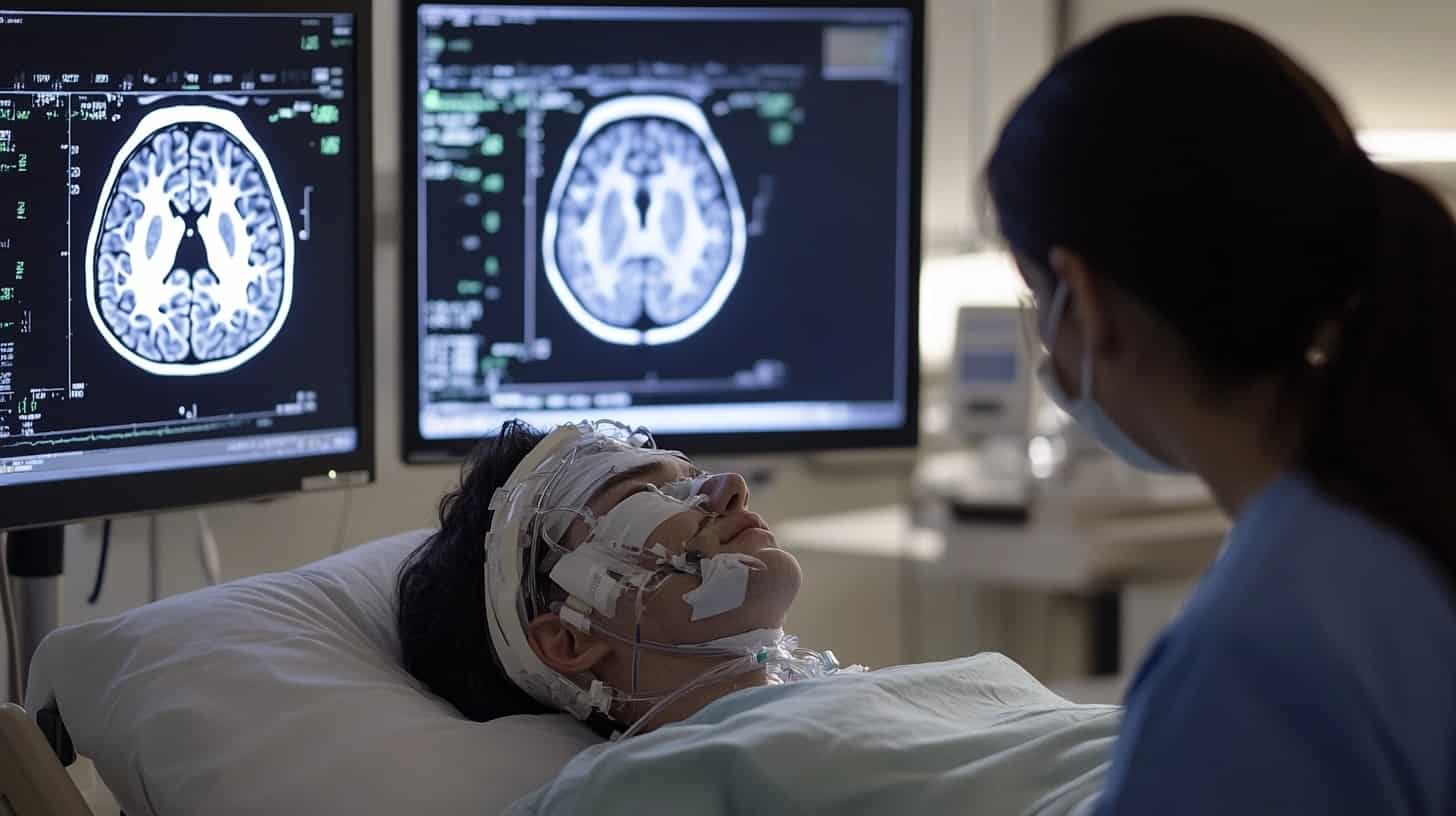
A patient with a head injury in the hospital
Oxford scientists design forensic AI tool for predicting causes of head injuries
Researchers at the University of Oxford have developed an AI tool that helps in forensic prediction of causes of head injuries.
Ad
In a press release on 26 February, the leading UK university said the tool will help law enforcement to unearth causes of traumatic brain injury (TBI), thus helping investigators to get more timely answers.
Findings of the research leading to this discovery have been published in Communications Engineering earlier today.
Solving a critical problem
Forensic investigators have had a hard time determining if an impact has caused a reported injury, although this is crucial for legal proceedings.
Ad
Up to this point, there is no standardized way to verify this, making it difficult to properly process such cases.
The new study outlines how machine learning tools can provide evidence-based injury predictions. Lead researcher Antoine Jérusalem,a Professor of Mechanical Engineering in the Department of Engineering Science, University of Oxford said:
“This research represents a significant step forward in forensic biomechanics. By leveraging AI and physics-based simulations, we can provide law enforcement with an unprecedented tool to assess TBIs objectively.”
With the AI tool trained 53 on real, anonymised police reports and assault cases data, it was able to achieve high prediction accuracy for TBI-related injuries.
The results show 94% accuracy for skull fractures, 79% accuracy for loss of consciousness, and 79% accuracy for intracranial haemorrhage (bleeding within the skull) with high specificity and high sensitivity.
Using a general computational mechanistic model of the head and neck designed to simulate different types of impacts, the framework provides a basic prediction of whether an impact is likely to cause tissue deformation or stress.
A higher AI model then combines this information with additional relevant metadata, such as the victim’s age and height, to provide a prediction for a given injury.
A word of caution
Although the AI tool showed remarkable results in predicting the cause of TBI, the researchers have warned that it is not intended to replace the involvement of human forensic and clinical experts in investigating assault cases.
Instead, it only provides an objective estimate of the probability that a documented assault was the true cause of a reported injury.
How do you rate this article?
Subscribe to our YouTube channel for crypto market insights and educational videos.






Join our Socials
Briefly, clearly and without noise – get the most important crypto news and market insights first.

Most Read Today
1
Samsung crushes Apple with over 700 million more smartphones shipped in a decade
2Peter Schiff Warns of a U.S. Dollar Collapse Far Worse Than 2008
3Dubai Insurance Launches Crypto Wallet for Premium Payments & Claims
4XRP Whales Buy The Dip While Price Goes Nowhere
5Luxury Meets Hash Power: This $40K Watch Actually Mines Bitcoin
Latest






8
Also read
Similar stories you might like.
Research
UK scientists develop easy breath test for early lung disease detection
Shedrach | 2025-09-26
Research
Oxford scientists to grow human brain cells in lab for Parkinson’s Disease study
Shedrach | 2025-02-14
Research
Researchers discover UK’s biggest Dinosaur footprints in quarry site
Shedrach | 2025-01-03