












Data center infrastructure supporting rollup data

Optimistic rollups are layer 2 protocols that execute transactions off-chain and post the resulting data back to Ethereum, assuming every batch is valid unless someone proves otherwise. That assumption is the entire trade-off: throughput jumps and gas costs drop, but users wait through a challenge window before withdrawals reach Ethereum with full finality. Arbitrum and Optimism are the two dominant implementations of this design.
TL;DR:
Latest StoriesRead all latest stories → Avalanche Has Crossed a Major Threshold — The Next Phase Starts Now
 The Real World Assets (RWA) Race Has Taken a New Turn
 This AI Token Is Building Momentum as Attention Shifts Back to AI Sector
- Larger, less frequent batches can significantly reduce the per-transaction cost, but smaller or more frequent batches increase costs and delay withdrawals.
- Rollup security depends on enough independent verifiers actively challenging invalid state roots within the challenge window, especially since posting a state root is only a commitment, not a proof of correctness.
- The introduction of blob transactions in March 2024 has drastically lowered data posting costs for rollups, enabling more scalability and lower fees with ongoing full Danksharding development.
- Optimistic rollups rely on post-hoc fraud proofs, resulting in withdrawal delays of around seven days, whereas ZK rollups offer near-instant finality through cryptographic proofs.
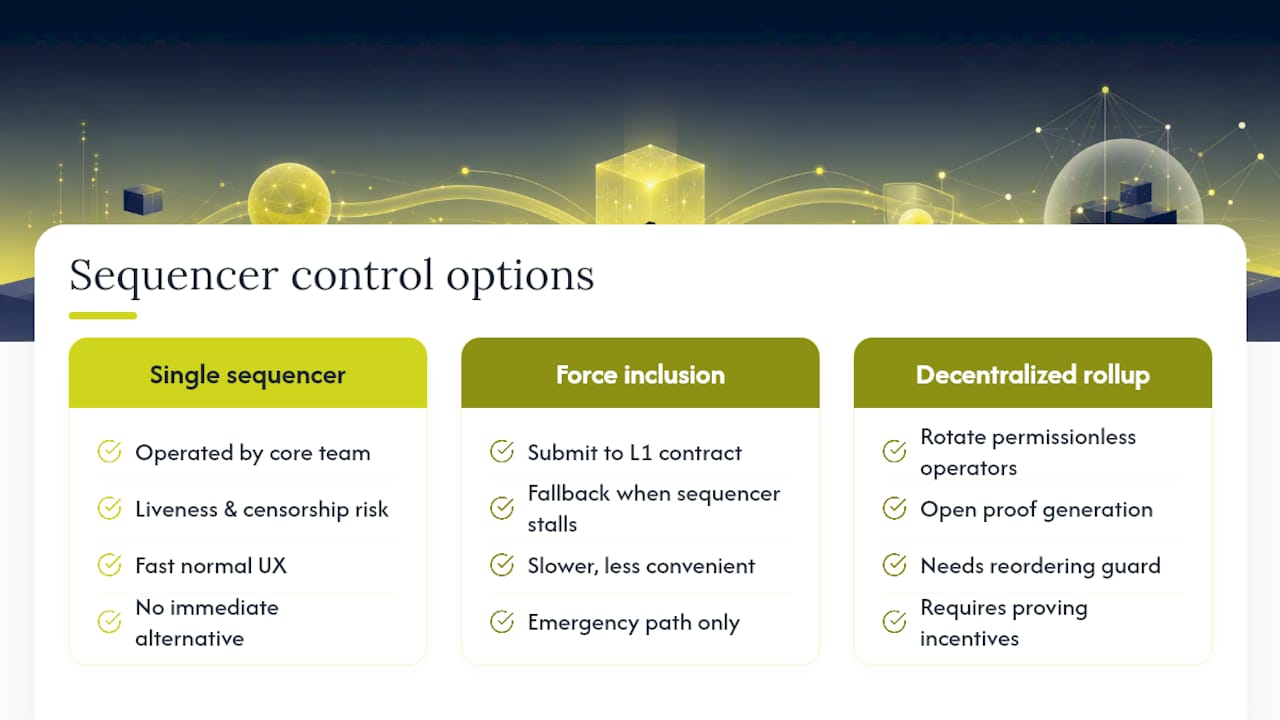
- The centralized role of the sequencer poses liveness and censorship risks, with ongoing efforts to decentralize and rotate sequencer operators for better security.
How Do Optimistic Rollups Work?
An optimistic rollup separates two jobs Ethereum normally does together: ordering transactions and verifying them. A sequencer handles ordering and execution off-chain, bundling hundreds or thousands of transactions into a single batch. That sequencer then submits the batch, along with a new state root, to a smart contract on Ethereum’s base layer.
The state root is a compact cryptographic fingerprint of the rollup’s entire account state after the batch executes. Each new root chains to the previous one, forming a ledger of state transitions that anyone can audit. If a sequencer posts a bad state root, the data needed to catch it has to be publicly available, which is why optimistic rollups derive their security from Ethereum’s base layer rather than from the sequencer’s honesty alone.
Where that data actually lives has changed dramatically. For years, rollups posted transaction data as calldata, a type of Ethereum transaction data that competes for the same block space as everything else on mainnet and gets stored permanently by every node. That permanence made it expensive. Since March 2024, most rollups instead use blobs, a temporary data structure introduced specifically for this purpose that Ethereum nodes only need to retain for about 18 days.
A few operational details matter if you’re building on top of one of these systems:
- Batching cadence is a direct cost lever: larger, less frequent batches amortize the fixed cost of an L1 transaction across more user activity.
- Compression matters almost as much as batching. Rollups strip redundant data (like repeated addresses) before posting, sometimes cutting payload size by more than half.
- Gas budgeting for a rollup transaction has two components: the L2 execution fee and a share of the L1 data-posting fee, and the second one used to dominate the total.
- State commitments are checkpoints, not proofs. Posting a state root doesn’t verify it’s correct. It just creates a public record someone can dispute.
That last point is the hinge the entire security model swings on.
What Happens During a Fraud-Proof Challenge?
Optimistic rollups don’t verify batches before accepting them. They accept everything by default and rely on a fraud proof mechanism to catch mistakes after the fact. Anyone running a full node can re-execute a posted batch, compare the result to the sequencer’s claimed state root, and if they don’t match, submit a fraud proof.
Two proving styles exist. A naive approach would re-execute the entire disputed transaction on Ethereum itself, which is exactly the computation cost rollups are trying to avoid. Modern implementations instead use interactive, multi-round proving: the challenger and the sequencer narrow the dispute step by step until they isolate the single computational step in question, and only that tiny step gets verified on L1.
The practical process looks like this:
- A batch is posted with its state root during a defined challenge window.
- A verifier re-executes the batch off-chain and checks for discrepancies.
- If a mismatch appears, the verifier submits a fraud proof and the dispute narrows through interactive rounds.
- Ethereum’s base layer settles the final disputed step and reverts the batch if the challenge succeeds.
Challenge windows on production networks run for a defined challenge window period, which causes withdrawal delays before funds reach Ethereum with full finality. That delay is the single biggest UX complaint developers hear from users moving assets off a rollup.
Verifiers aren’t volunteers out of goodwill. Rollup designs bond sequencers and reward successful challengers, sometimes slashing the bonded stake of a party caught posting invalid data. Ethereum.org notes that trustlessness depends on having enough independent verifiers actually watching the chain, not just the existence of the fraud-proof mechanism itself.
Pro Tip: If your dApp handles time-sensitive withdrawals, don’t design your UX around the optimistic assumption that no challenge will ever occur. Build for the seven-day worst case, then treat faster paths as a bonus.
How Did Proto-Danksharding Change Rollup Costs?
Data availability, not computation, is what caps how much a rollup can scale. Every transaction still has to be published somewhere Ethereum nodes can access it, and until recently that meant competing for the same calldata space as every other application on mainnet.
Historically, more than 90% of a rollup transaction’s total cost came from posting data to L1, according to ethereum.org’s scaling roadmap. Execution was cheap. Publishing the proof of what happened was not.
Proto-Danksharding, defined in EIP-4844 and activated with the Dencun upgrade in March 2024, introduced blob-carrying transactions as a separate, cheaper data lane on Ethereum. Blobs don’t compete with regular calldata for block space, and nodes prune them after roughly 18 days instead of storing them forever.
Full Danksharding is the next phase, layering in data availability sampling (DAS) and proposer-builder separation (PBS) so nodes can verify blob availability without downloading every byte. Combined with continued rollup optimization, ethereum.org’s roadmap projects more than 100x additional scaling headroom once these pieces land, though the engineering work on DAS and PBS is still ongoing.
For an optimistic rollup specifically, cheaper blob space means the sequencer’s dominant cost line shrank, and that savings flows straight through to lower per-transaction fees for end users.
Optimistic Rollups vs. ZK Rollups: What’s the Real Difference?
Both approaches solve the same problem, moving execution off Ethereum’s base layer, but they disagree on how to prove correctness, and that disagreement cascades into everything else.
- Proof model: Optimistic rollups assume validity and rely on fraud proofs after the fact. ZK rollups generate a validity proof for every batch before it’s ever accepted.
- Finality: A ZK rollup’s cryptographic proof is verified on L1 almost immediately, giving near-instant finality. An optimistic rollup withdrawal typically waits out the full challenge window, commonly around seven days.
- EVM compatibility: Optimistic rollups generally offer easier EVM compatibility, since they just re-execute standard Ethereum bytecode. ZK rollups have historically needed custom circuits or zkEVM translation layers to achieve the same coverage, which raises porting costs for existing dApps.
- Cost profile: ZK proof generation is computationally expensive, though that cost is shrinking as proving hardware improves. Optimistic rollups skip that cost entirely but carry the ongoing overhead of maintaining a verifier community to catch fraud.
Neither model is strictly better. A dApp that needs instant, exchange-grade withdrawal finality leans toward ZK. A team porting a large, existing Solidity codebase with minimal rework usually finds the optimistic path faster to ship.
Who Really Controls the Sequencer?
Almost every production optimistic rollup runs a single sequencer today, typically operated by the core development team. Optimism’s own protocol documentation acknowledges that this concentration creates liveness and censorship risk: if that one sequencer goes down or chooses to exclude certain transactions, users have no immediate alternative path to get a transaction included.
The fallback in most designs is a “force inclusion” mechanism, letting users submit transactions directly to the L1 contract if the sequencer stalls, but that path is slower and less convenient than normal use.
Decentralizing this role means rotating sequencer duties among a permissionless set of operators, plus opening up proof generation so no single prover can stall or manipulate the dispute process. Neither step is simple. Sequencer rotation needs a mechanism to prevent transaction reordering attacks, and open proving needs an incentive structure that makes honest participation more profitable than sitting out. Decentralization roadmaps across the major rollups are progressing on different timelines, and this is the area worth watching most closely if you’re evaluating a rollup’s long-term risk profile rather than its current fee schedule.
What Should Developers and Users Actually Do About Withdrawal Delays?
The core bridging flow runs deposit onto the rollup (fast, usually minutes), then withdrawal back to L1 (slow, gated by the challenge window). That asymmetry is by design, not a bug.
Third-party liquidity providers offer a workaround: they front you L1 funds immediately in exchange for a fee, then collect your rollup withdrawal themselves once the challenge window closes. It’s convenient, but it introduces counterparty risk and a cost that scales with market demand for that liquidity.
A practical checklist for teams building on an optimistic rollup:
- Test against the actual challenge window length, not an idealized instant-finality assumption.
- Budget gas estimates using current blob prices, not pre-Dencun calldata benchmarks.
- Monitor sequencer uptime and have a documented fallback path for users if it stalls.
- Evaluate verifier tooling maturity before assuming fraud proofs will catch every edge case on day one.
Pro Tip: If your users frequently move small amounts, the fee for instant third-party withdrawal often outweighs the wait. Save the liquidity-provider route for larger transfers where the time value of capital actually justifies the cost.
What Changed for Optimistic Rollups After Dencun?
The Dencun upgrade activated Proto-Danksharding in March 2024, introducing blob transactions that cut the dominant cost driver for rollup data posting. Adoption followed quickly, with blob usage climbing and per-transaction fees on major rollups dropping. Full Danksharding, with data availability sampling and proposer-builder separation, remains the unfinished half of this roadmap.
Where to Verify the Technical Details
Start with ethereum.org’s optimistic rollup documentation, the Ethereum scaling roadmap, and Optimism’s protocol overview for primary-source specifics.
Techgaged tracks how these protocol changes ripple into market behavior, including how Optimism’s activity has intersected with Bitcoin’s price action and broader Ethereum market dynamics. For the regulatory side of the L2 ecosystem, our coverage of proposed crypto legislation is worth a read. If you’re tracking how institutional capital is responding to Ethereum’s scaling progress, our report on Fidelity’s latest Ethereum ETF move connects the protocol upgrades covered here to real capital flows. For ongoing coverage of blockchain scalability, DeFi, and market trends, visit Techgaged.
Sources
FAQ
How Do I Bridge ETH to Optimism?
You deposit ETH through Optimism’s official bridge contract, which locks the funds on Ethereum and mints an equivalent balance on the rollup, typically within minutes. Withdrawing back to Ethereum takes longer because it passes through the standard seven-day challenge window unless you use a third-party liquidity provider.
What Does ZK Rollup Mean?
A ZK rollup is a layer 2 scaling protocol that bundles transactions off-chain and submits a cryptographic validity proof to Ethereum, confirming correctness immediately rather than relying on a post-submission challenge period.
How Do Rollups Work in General?
Rollups execute transactions off Ethereum’s base layer, then post compressed transaction data or state commitments back to L1 so the chain’s security still backs the results. Optimistic rollups verify this data through fraud proofs after the fact, while ZK rollups verify it with a mathematical proof before the batch is accepted.
What Are Blockchain Rollups and How Do They Reduce Costs?
Rollups reduce costs by moving computation off Ethereum’s congested base layer and posting only compressed data or proofs back on-chain, spreading the fixed cost of an L1 transaction across many bundled transactions. The 2024 shift to blob storage under Proto-Danksharding cut this data-posting cost further, since blobs don’t compete with regular transactions for the same block space.
How Does Arbitrum Compare to Optimism?
Both are optimistic rollups sharing the same fraud-proof security model and roughly similar challenge windows, but they differ in fraud-proof implementation details, governance structure, and ecosystem tooling. Neither has a fundamentally different data availability approach since both adopted blob storage after Dencun.
Recommended
How do you rate this article?
Subscribe to our YouTube channel for crypto market insights and educational videos.






Join our Socials
Briefly, clearly and without noise – get the most important crypto news and market insights first.
Most Read Today
1
Recalibrate MVRV Now, Analysts: Why 3.5 Fails in the ETF Era
2Avalanche Has Crossed a Major Threshold — The Next Phase Starts Now
3Bitcoin Clears Its Biggest Leverage Test Since 2023
4The Real World Assets (RWA) Race Has Taken a New Turn
5This AI Token Is Building Momentum as Attention Shifts Back to AI Sector
Latest





8
Also read
Similar stories you might like.

Crypto News
Avalanche Has Crossed a Major Threshold — The Next Phase Starts Now
Azeez | 2026-09-07

Crypto News
The Real World Assets (RWA) Race Has Taken a New Turn
Azeez | 2026-09-07

Crypto News
This AI Token Is Building Momentum as Attention Shifts Back to AI Sector
Azeez | 2026-09-07

Crypto News
Bitcoin Clears Its Biggest Leverage Test Since 2023
Azeez | 2026-09-07

Crypto Guides
Recalibrate MVRV Now, Analysts: Why 3.5 Fails in the ETF Era
Rokas | 2026-09-07

Crypto News
Bitcoin ETF Demand Is Back — Now the Market Faces Its Next Test
Azeez | 2026-09-06

Crypto News
XRP Trading Volume Surges to a February High — Something Is Changing
Azeez | 2026-09-07

Crypto News
Solana Is Processing More Than the Rest — What Comes Next Could Be Bigger
Azeez | 2026-09-06

Crypto News
Ethereum Is Building Something Bigger Than the Crypto Market
Azeez | 2026-09-06

Crypto Guides
NFT Royalties: The Enforcement Gap That Cuts Creator Income
Rokas | 2026-09-06