













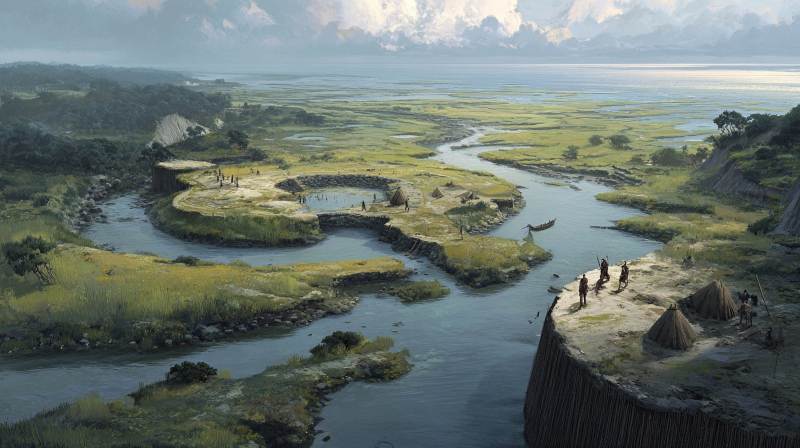
An aerial view of land patches on the ocean
A long lost land bridge linking Africa, Europe, and Asia has been rediscovered by archaeologists, challenging the existing records of human history.
Ad
A paper published on 17 September provides details of Ayvalık, a region in western Anatolia that has remained largely unexamined in Pleistocene archaeology.
Archaeologists discovered ancient artifacts such as handaxes and cleavers as well as blade and bladelet technologies, showing the importance of Ayvalık in ancient northeastern Aegean and for future research.
A hidden path
Ayvalık, an archaeologically understudied region, forms a transitional zone between the North Aegean and the Anatolian mainland.
Ad
There were times when the tides went down, and during such periods provided direct links between Anatolia and southeastern Europe, such as Rodafnidia on the island of Lesvos.
As a region intermittently exposed as dry land during periods of lowered sea level, it provided opportunities for early humans to settle and provided a path for them to travel from one place to another.
However, the region has remained largely unexplored until now. Surveys conducted in the region identified 138 lithic artifacts at 10 sites among many other findings that suggested human presence and activity in the site many years ago.
According to the researchers, humans may have occupied the region from approximately 1 million to 400,000 years ago.
The paper stated:
“Despite preservation challenges due to Ayvalık’s geology and dynamic coastal processes, these findings reveal a previously undocumented Paleolithic presence and establish Ayvalık as a promising locus for future research on early human dispersals in the northeastern Aegean.”
Questioning recorded human history
With the discovery of Ayvalık, many people may be wondering what else scientists and archaeologists may have left out of human history.
For example, while we have been taught from childhood about the solar system, more planets have been discovered since then, and astronomers recently discovered a mysterious object moving in sync with Neptune.
How do you rate this article?
Subscribe to our YouTube channel for crypto market insights and educational videos.






Join our Socials
Briefly, clearly and without noise – get the most important crypto news and market insights first.

Most Read Today
1
Peter Schiff Warns of a U.S. Dollar Collapse Far Worse Than 2008
2Samsung crushes Apple with over 700 million more smartphones shipped in a decade
3Dubai Insurance Launches Crypto Wallet for Premium Payments & Claims
4XRP Whales Buy The Dip While Price Goes Nowhere
5Luxury Meets Hash Power: This $40K Watch Actually Mines Bitcoin
Latest




Most Read Today

MOST ENGAGING
8
Also read
Similar stories you might like.

Research
Secret Workshops? New 3D Model Redraws Easter Island’s Moai Origin Story
Ana | 2025-11-27

Artificial Intelligence
Latin scholars use AI to crack ancient Roman text mysteries
Ana | 2025-07-28
Research
Archaeologists unearth fossil of unknown dinosaur-era mammal in Mongolian desert
Ana | 2025-04-29

Research
DNA evidence: Stone Age Europeans sailed to Africa
Ana | 2025-03-24