












Person holding Ethereum tokens over their eyes. Source: TechGaged / Shutterstock
Joe Lubin Sees Ethereum Going All-In on ZK Proofs
In Brief
- • Lubin says Ethereum could become fully ZK-powered within five years.
- • ZK technology may help scale Ethereum and strengthen its base layer.
- • The vision aims to make Ethereum’s ecosystem more unified.

Ethereum (ETH) could transition into a fully zero-knowledge (ZK) proof-based protocol within the next three to five years, according to Consensys CEO Joseph Lubin. The Ethereum co-founder said advances in real-time ZK proving, Layer 2 infrastructure, and initiatives such as Lean Ethereum could eventually reshape both Ethereum’s base layer and its relationship with rollups. His comments come as Ethereum leaders continue rethinking the network’s long-standing rollup-centric scaling strategy.
Joe Lubin Says Ethereum’s Future Is Zero-Knowledge
Speaking to The Block in a June 10 interview, Lubin argued that Ethereum’s path forward involves strengthening the base layer and continuing to benefit from innovations developed across the Layer 2 ecosystem.
“I’m a big fan of the rollup-centric roadmap,” Lubin said, adding that emerging technologies are making both rollups and Ethereum itself significantly more powerful.
Latest Stories
Bitcoin Near Historic Bottom Zone as Demand Collapses

Mastercard Launches Stablecoin-Powered AI Economy

A Rare Cardano Signal Just Appeared for the First Time in Weeks
One of the most important developments, he argued, is the growing adoption of zero-knowledge cryptography. According to Lubin, Ethereum could evolve into a fully zero-knowledge proof-based protocol within three to five years, improving scalability and also increasing composability between the main network and Layer 2 chains.
The vision aligns with Lean Ethereum, a proposal from Ethereum Foundation researcher Justin Drake that seeks to simplify Ethereum’s architecture and dramatically increase performance. The initiative targets more than 10,000 transactions per second without sacrificing decentralization, security, or censorship resistance.
The comments also arrive amid broader changes to Ethereum’s scaling strategy. Earlier this year, Vitalik Buterin publicly acknowledged that the original rollup-centric vision hadn’t fully materialized, arguing that many Layer 2 networks had become little more than “branded shards.” Ethereum’s leadership has since renewed its focus on making the base layer faster and more competitive with rival blockchains.
Layer 2s May Help Reunify Ethereum’s Fragmented Ecosystem
Despite criticism of the rollup roadmap, Lubin maintained that Layer 2 networks remain essential to Ethereum’s long-term development.
According to him, Ethereum’s ecosystem intentionally entered a period of fragmentation to allow competing scaling technologies to mature. Rollups provided an environment where difficult innovations such as real-time zero-knowledge proving could be tested before eventually moving to the main network.
“We always knew that zero-knowledge proofs were going to be significant in our ecosystem. (…) We thought they would be significant first at Layer 2. And we were right.”
Lubin pointed to projects such as Linea and Gnosis, which are already using ZK technology to enable increasingly seamless interaction between networks. Over time, he believes those capabilities could support what he described as a “single atomic execution context,” which would allow users to move assets across Ethereum-based networks without relying on bridges.
Such a system could help solve one of Ethereum’s biggest criticisms: fragmented liquidity spread across dozens of Layer 2 ecosystems. By enabling synchronous transaction execution and shared liquidity, Lubin argues that Ethereum is now entering a convergence phase after years of divergence.
He also revealed that several groups focused on protocol development, scalability and institutional adoption are expected to spin out from the Ethereum Foundation, though he rejected speculation that a second Ethereum foundation is being created.
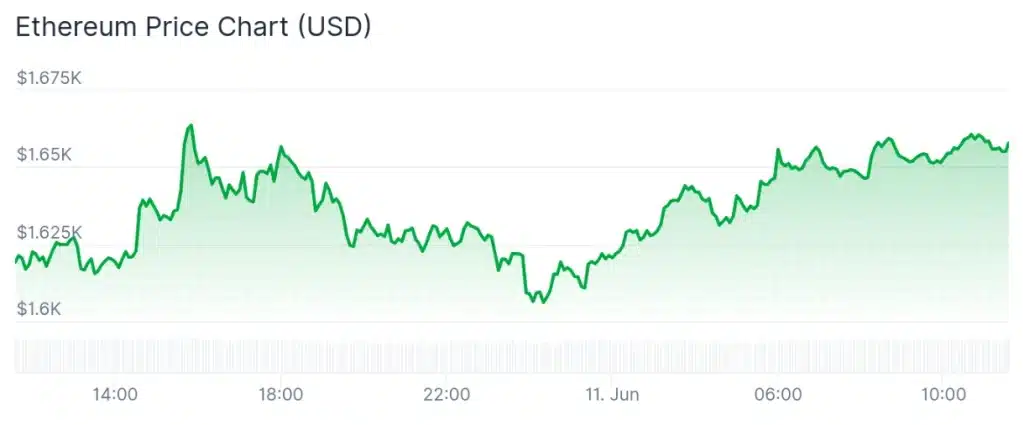
Meanwhile, ETH was at press time changing hands at the price of $1,657.81, up 2.4% on the day, down 6.8% over the week, and accumulating a decline of 27.9% across the past month, according to the most recent chart information.
If Lubin’s timeline proves accurate, Ethereum’s next major evolution may not come from a single upgrade, but from gradually turning the world’s second-largest blockchain into a network built almost entirely around zero-knowledge cryptography.
How do you rate this article?
Subscribe to our YouTube channel for crypto market insights and educational videos.






Join our Socials
Briefly, clearly and without noise – get the most important crypto news and market insights first.
Most Read Today
1
“Don’t Panic”: Binance Founder Breaks Silence on Bitcoin Crash
2Avalanche’s RWA Ecosystem Is Exploding — What Comes Next for AVAX?
3Japan’s $7 Trillion Banking Titans Team Up for Yen Stablecoin
4This Ethereum Metric Predicts the Next Big Move
5Billionaire Tim Draper Warns Banks Face Quantum Risk Before Bitcoin
Latest





8
Also read
Similar stories you might like.

Altcoins
Bitcoin Near Historic Bottom Zone as Demand Collapses
Ana | 2026-06-11

Blockchain
Mastercard Launches Stablecoin-Powered AI Economy
Ana | 2026-06-11

Crypto News
Old Raydium Code Comes Back to Bite in $1.34M Exploit
Rokas | 2026-06-11

Altcoins
Japan Just Gave Crypto Its Biggest Regulatory Win Yet
Rokas | 2026-06-11

Crypto News
This Ethereum Metric Predicts the Next Big Move
Azeez | 2026-06-10

Altcoins
Blood Returns to Crypto as BTC Loses Momentum
Ana | 2026-06-10

Bitcoin
Robert Kiyosaki Rejects ETFs in New Bitcoin Warning
Ana | 2026-06-10

Bitcoin
“Don’t Panic”: Binance Founder Breaks Silence on Bitcoin Crash
Ana | 2026-06-10

Bitcoin
Billionaire Tim Draper Warns Banks Face Quantum Risk Before Bitcoin
Rokas | 2026-06-10

Crypto News
Japan’s $7 Trillion Banking Titans Team Up for Yen Stablecoin
Rokas | 2026-06-10