








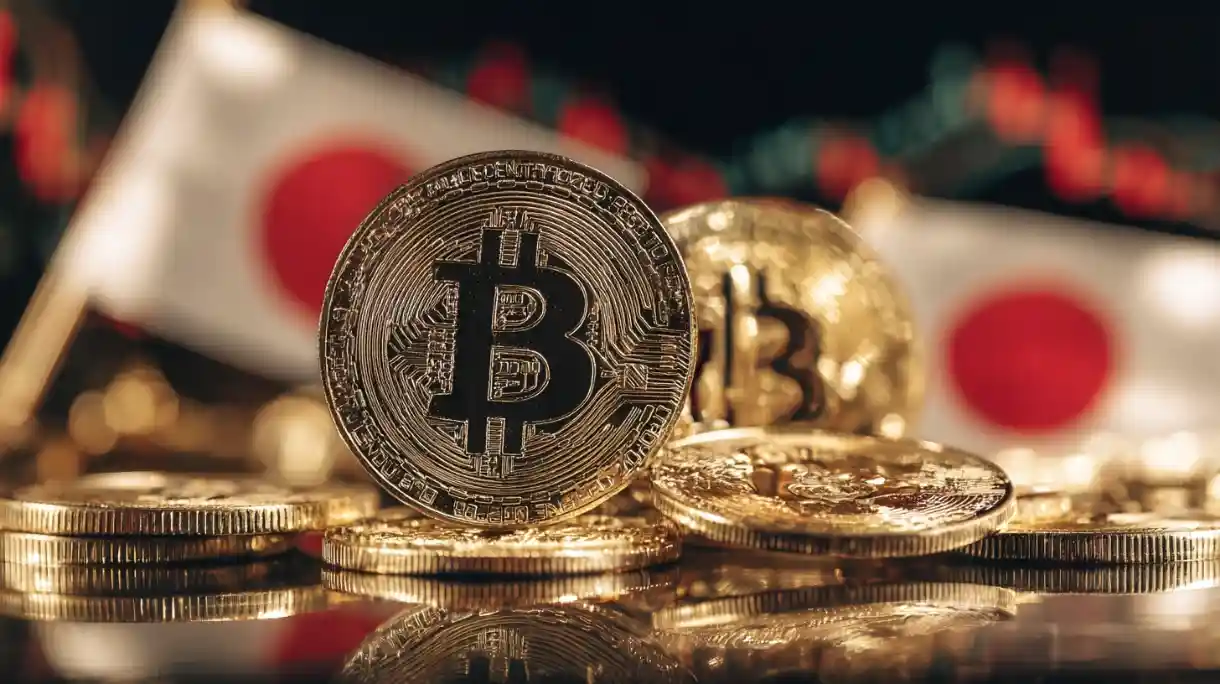
Japan’s Finance Minister Backs Crypto Access Via Stock Exchanges
Japan’s Finance Minister Backs Crypto Access Via Stock Exchanges
In Brief
- • Japan plans to expand crypto access through traditional stock exchanges.
- • Officials point to U.S.-style crypto ETFs as a model.
- • The shift aims to mainstream digital assets by 2026.
Ad
Japan is laying the groundwork for deeper cryptocurrency adoption within its traditional financial system, as senior policymakers signal strong support for integrating digital assets into stock and commodity exchanges.
During a New Year’s address at the Tokyo Stock Exchange, Satsuki Katayama, Japan’s Minister of Finance and Financial Services, described exchanges as playing a “crucial” role in expanding public access to digital and blockchain-based assets.
Her remarks point to a potential shift in how crypto is distributed and accessed in Japan, and one that moves it closer to the country’s core financial infrastructure.
Exchanges As The Gateway To Crypto
Katayama emphasized that stock and commodity exchanges are uniquely positioned to help ordinary investors benefit from digital assets. Rather than relying solely on standalone crypto platforms, she argued that regulated exchanges could serve as trusted access points for blockchain-based products.
This approach mirrors trends seen in the United States, where crypto exchange-traded funds (ETFs) have allowed investors to gain exposure to Bitcoin (BTC) and other assets through familiar market vehicles.
Although Japan currently has no domestically listed crypto ETFs, Katayama’s comments suggest that similar products could eventually emerge.

Learning From The U.S. ETF Model
Referencing U.S. markets, Katayama noted how crypto ETFs have become widely used as inflation-hedging tools. That comparison underscores a broader policy view: crypto is no longer treated solely as a speculative instrument, but as part of a diversified financial toolkit. Indeed, as she pointed out:
“In the U.S., [crypto] is spreading in the form of ETFs as a means of hedging the inflation.”
If Japan follows a similar path, crypto exposure could increasingly flow through traditional brokers and exchanges rather than niche platforms in a shift that would likely accelerate mainstream adoption.
2026 As Japan’s “Digital Year”
Katayama formally designated 2026 as Japan’s “digital year,” pledging full government support for exchanges seeking to build next-generation trading environments using advanced fintech and blockchain technology.
Her comments also tied digital asset integration to Japan’s broader economic goals. She described the coming year as a turning point for addressing long-standing challenges such as deflation, emphasizing proactive fiscal policy and investment in growth sectors.
Crypto and digital assets, in this framing, become part of a wider modernization strategy rather than a standalone experiment.
Why This Matters For Crypto Markets
Japan has long been one of the world’s most regulated and influential crypto markets. Signals from top financial officials carry weight not only domestically, but across Asia-Pacific markets watching for regulatory cues.
While concrete policy steps have yet to be announced, the message is clear: Japan sees digital assets as compatible with, and potentially enhanced by, traditional financial infrastructure.
If these plans materialize, 2026 could mark a pivotal moment in how crypto intersects with global capital markets.
More Must-Reads:
How do you rate this article?
Subscribe to our YouTube channel for crypto market insights and educational videos.






Join our Socials
Briefly, clearly and without noise – get the most important crypto news and market insights first.

Most Read Today
1
Chainlink’s 499% Social Volume Spike: Why Attention is Outpacing Price
2Cardano (ADA) Price Analysis: Quiet Accumulation as Technical Signals Begin to Strengthen
3Mantle’s $1B Milestone: Why MNT is the Next Layer 2 Powerhouse to Watch
4Digital Silver’s Silent Strength: Litecoin (LTC) Fundamental and Technical Dive
5Zcash: The VC-Backed Rebirth of Private Finance
Latest





8
Also read
Similar stories you might like.

Altcoins
Chainlink’s 499% Social Volume Spike: Why Attention is Outpacing Price
Azeez | 2026-03-15

Altcoins
The Institutional Push: Why the Aptos & Mastercard Alliance is a High-Stakes Bet for 2026
Azeez | 2026-03-14

Altcoins
The Institutional Green Light: Analyzing AVAX as Grayscale’s Staking ETF Hits Nasdaq
Azeez | 2026-03-14

Altcoins
The Pi Day Pivot: Can Polkadot’s Massive Supply Cut Fuel a DOT Breakout?
Azeez | 2026-03-14

Altcoins
Ethereum Foundation Drops New Manifesto For The Network; What’s New?
Ana | 2026-03-13
Altcoins
XRP Triangle Pattern Points To Major Upside Target
Ana | 2026-03-13

Altcoins
Whales Quietly Scoop Up Millions Of TRUMP Tokens; What’s Happening?
Rokas | 2026-03-13
Bitcoin
Supply Shock: 204K BTC Leave Exchanges As Whales Stay Dormant
Rokas | 2026-03-13
Bitcoin
Record Strategy Bitcoin Purchase Raises Supply Pressure Questions
Rokas | 2026-03-13
Bitcoin
Should You Sell Bitcoin at $100K? Here’s What ChatGPT Says
Rokas | 2026-03-12