












From science fiction to your living room: Scientists grow glow-in-the-dark succulents
From science fiction to your living room: Scientists grow glow-in-the-dark succulents
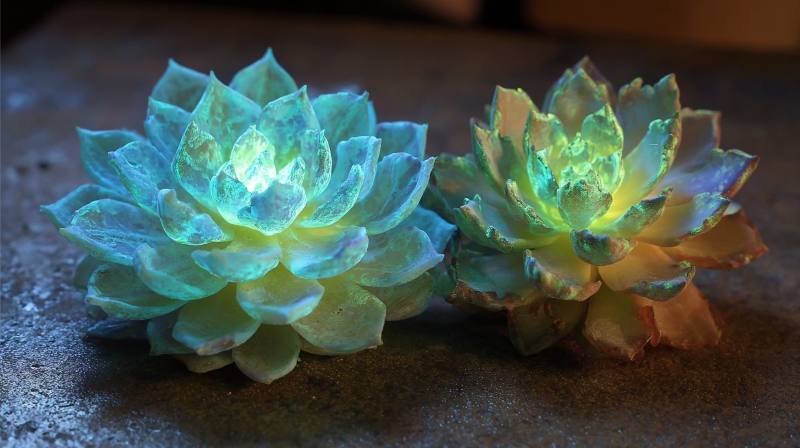
As scientific developments continue to shape our everyday lives, some include developing new types of species, be it in terms of fauna or flora, as scientists have managed to engineer glow-in-the-dark succulent plants that shine in a rainbow of colors.
Ad
Indeed, researchers, led by Xuejie Zhang, a materials scientist at the South China Agricultural University in Guangzhou, China, have created succulents that glow in the dark, turning ordinary houseplants into rechargeable night-lights, as described in the journal Matter on August 27.
Now, all the regular types of succulents have competition in the form of these luminescent succulent plants, specifically Echevaria ‘Mebina’, a common houseplant that grows rosettes of dense, fleshy leaves, which the scientists have injected with phosphor particles.

How glow-in-the-dark succulents work
As it happens, the luminescence, created in a ten-minute injection process, is in hues of blue-green, blue-violet, red, green, and white, can last up to 120 minutes after exposing the plant to customized wavelengths of light or sunlight, and could be triggered repeatedly over the 10 days of the study’s duration.
Ad

Additionally, the cost of materials to create one plant is $1.40, as the scientists estimate, which could make them a very popular decoration or gift everywhere. In the future, the team hopes to move away from having to inject each leaf separately by using smaller particles, but this currently leads to a dimmer glow.
Meanwhile, other popular, yet more traditional plant species include corpse flowers, which are under threat of extinction due to various factors, including habitat destruction, climate change, invasive species encroachment, and, more recently discovered, incomplete historical records.
Testifying to the corpse flower’s popularity is the presence of over 20,000 visitors witnessing the first blooming of the corpse flower in 15 years in the Royal Botanic Garden in Sydney, Australia, earlier this year, as only an estimated 162 individual corpse flowers remain in the wild.
How do you rate this article?
Subscribe to our YouTube channel for crypto market insights and educational videos.






Join our Socials
Briefly, clearly and without noise – get the most important crypto news and market insights first.
Most Read Today
1
Peter Schiff Warns of a U.S. Dollar Collapse Far Worse Than 2008
2Samsung crushes Apple with over 700 million more smartphones shipped in a decade
3Dubai Insurance Launches Crypto Wallet for Premium Payments & Claims
4XRP Whales Buy The Dip While Price Goes Nowhere
5Luxury Meets Hash Power: This $40K Watch Actually Mines Bitcoin
Latest





8
Also read
Similar stories you might like.

Industry
Google Searches for “How to Buy Gold” Explode Globally, Hitting a Two-Decade High
Rokas | 2026-01-26

Industry
Businesses now use crypto as operational capital, CoinGate data reveals a structural shift
Rokas | 2026-01-21

Bitcoin
$455 Billion in Bitcoin Exposed to Quantum Attack Risk via Address Reuse, Up 16% Since 2020
Jastra | 2026-01-20

Altcoins
Iran’s Crypto Activity Surges During Protests; Here’s Why
Ana | 2026-01-16

Industry
Stablecoin Market Share Hits an All-Time High of 10.19%
Jastra | 2026-01-14
No image

Bitcoin
Only Three Governments Increased Bitcoin Holdings in 2025 – U.S. Leads Following 130,000 BTC Seizure
Jastra | 2026-01-05

Industry
Solana Tokens Lose $157B in 2025, The Largest Dollar-Value Drop in the Chain’s History
Jastra | 2025-12-30
Artificial Intelligence
New Epstein Disclosures Collide With an AI Project Built Months Earlier
Ana | 2025-12-22

Science
Scientists Reconstruct Skull of 1.6-Million-Year-Old Ethiopian Homo Erectus
Shedrach | 2025-12-19