












Astronomers discover planet with orbit mirroring Star Wars' Tatooine twin-sun system
Astronomers discover exoplanet with orbit mirroring Star Wars’ Tatooine twin-sun system
As our final frontier still remains largely unexplored, scientists have made an exciting and unusual discovery that resembles a planetary setup from the beloved Star Wars franchise.
Ad
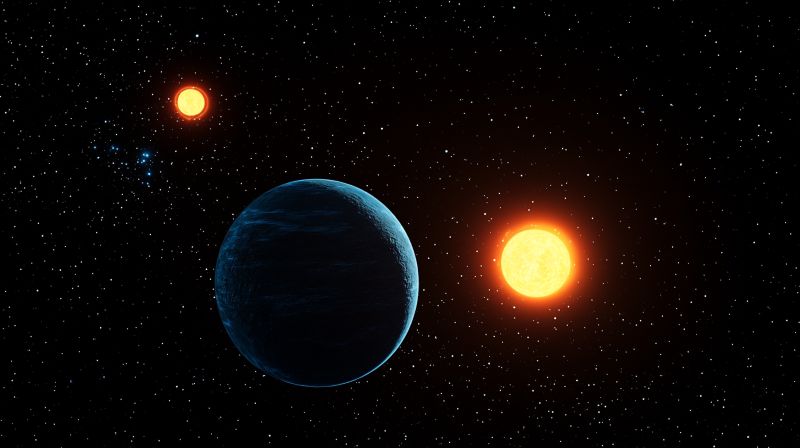
Indeed, astronomers led by the University of Birmingham have discovered a planet orbiting at a 90-degree angle around two odd stars in a setup reminiscent of the twin-sun system of Luke Skywalker’s home planet of Tatooine, according to a report published by Phys.org on April 16.
Specifically, the exoplanet with an equally exotic name – 2M1510 (AB) b – orbits two young brown dwarfs, which refer to space objects larger than gas-giant planets but not big enough to be proper stars, which is only the second such dual-dwarf orbiting system found so far.
Discovering the twin-sun system
As it happens, the researchers have used the European Southern Observatory’s Very Large Telescope (VLT) when they made the surprising discovery of the ‘eclipsing binary,’ in which the brown dwarfs eclipse one another as seen from Earth.
Ad
At the same time, it is the first strong evidence of a ‘polar circumbinary exoplanet’ in stable orbit of a stellar pair ever collected, although its “theoretical and observational basis has been postulated before.” Commenting on the discovery, Thomas Baycroft, a PhD student at the University of Birmingham who led the study, said:
“We had hints that planets on perpendicular orbits around binary stars could exist, but until now we lacked clear evidence of this type of polar planet. We reviewed all possible scenarios, and the only consistent with the data is if a planet is on a polar orbit about this binary.”
In the words of the study’s co-author Professor Amaury Triaud, a “planet orbiting not just a binary, but a binary brown dwarf, as well as being on a polar orbit is rather incredible and exciting [and] shows what is possible in the fascinating universe we inhabit.”
Elsewhere, on humanity’s never-ending quest of finding life in outer space, scientists believe there could be some in our own solar system, as close as Saturn’s largest moon, Titan, although the life forms potentially existing there would probably be minuscule.
How do you rate this article?
Subscribe to our YouTube channel for crypto market insights and educational videos.






Join our Socials
Briefly, clearly and without noise – get the most important crypto news and market insights first.
Most Read Today
1
Samsung crushes Apple with over 700 million more smartphones shipped in a decade
2Peter Schiff Warns of a U.S. Dollar Collapse Far Worse Than 2008
3Dubai Insurance Launches Crypto Wallet for Premium Payments & Claims
4XRP Whales Buy The Dip While Price Goes Nowhere
5Luxury Meets Hash Power: This $40K Watch Actually Mines Bitcoin
Latest





8
Also read
Similar stories you might like.

Industry
Google Searches for “How to Buy Gold” Explode Globally, Hitting a Two-Decade High
Rokas | 2026-01-26

Industry
Businesses now use crypto as operational capital, CoinGate data reveals a structural shift
Rokas | 2026-01-21

Bitcoin
$455 Billion in Bitcoin Exposed to Quantum Attack Risk via Address Reuse, Up 16% Since 2020
Jastra | 2026-01-20

Altcoins
Iran’s Crypto Activity Surges During Protests; Here’s Why
Ana | 2026-01-16

Industry
Stablecoin Market Share Hits an All-Time High of 10.19%
Jastra | 2026-01-14
No image

Bitcoin
Only Three Governments Increased Bitcoin Holdings in 2025 – U.S. Leads Following 130,000 BTC Seizure
Jastra | 2026-01-05
Industry
Solana Tokens Lose $157B in 2025, The Largest Dollar-Value Drop in the Chain’s History
Jastra | 2025-12-30

Artificial Intelligence
New Epstein Disclosures Collide With an AI Project Built Months Earlier
Ana | 2025-12-22

Artificial Intelligence
Scientists Use AI to Crack Nature’s Hidden Laws
Ana | 2025-12-18