









Ants can 'teach' how to program self-driving cars
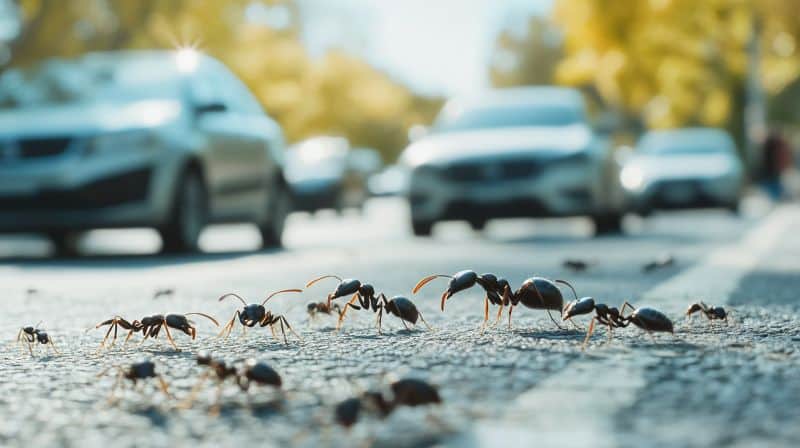
Ants may be the key to preventing future traffic jams as we could learn a lesson or two from their natural cooperative tactics and behavior that prioritizes efficiency in movement and apply them in programming self-driving vehicles.
Ad
Indeed, one of the main causes of traffic congestion is the increase in the density of cars on a highway. If there are 15 vehicles per mile in each lane, it’s enough for just one driver to tap their brakes and voilà – a persistent traffic jam ensues, Scientific American writes.
Unlike us, ants have evolved efficient strategies that scientists are now studying so they can teach self-driving cars to avoid traffic jams. According to a recent study, the small black Ochetellus ants travel in groups of three to 20, moving at nearly constant rates.
At the same time, they are able to keep a comfortable distance between one another and they never speed up to pass others. On the other hand, human drivers don’t usually feel like adhering to such rules during rush hour. As the study’s co-author, Nicola Pugno, who studies sustainable engineering at the University of Trento in Italy, pointed out:
Ad
“We’re maximizing the interests of individuals, [which] is why, at a given point, you start to have a traffic jam.”
Do self-driving cars learn?
As it happens, self-driving cars learn to drive, and perform better, as well as more safely, than any human driver could do behind the wheel. And thanks to researchers at NYU Tandon School of Engineering, they could soon share road knowledge through digital word-of-mouth.
How are self-driving cars taught? Teaching a car to drive efficiently occurs through the utilization of deep learning and vast amounts of processing power, both in the data center where the car’s artificial intelligence (AI) ‘brain’ is trained and within the vehicle itself.
This also begs the question: How do self-driving cars know when to stop or how to perform other actions? Autonomous vehicles use cameras and electronic sensors to ‘perceive’ the world around them, detecting things like the road and traffic signs, as well as other traffic participants, such as pedestrians and other cars.
All things considered, it is possible to ‘feed’ self-driving cars’ systems with data on ants’ traveling behavior in order to introduce more cooperative programming and sharing of information with nearby cars, such as prioritizing constant speeds and not passing others on the road – much like ants on a trail using their scent to interact and coordinate.
Meanwhile, autonomous vehicles are on their way to becoming omnipresent, with Mercedes Benz cleared for Level 3 autonomous driving, fully unmanned robotaxis and robobuses driving passengers around, and advances such as warships and AI-powered RVs already here.
How do you rate this article?
Subscribe to our YouTube channel for crypto market insights and educational videos.






Join our Socials
Briefly, clearly and without noise – get the most important crypto news and market insights first.
Most Read Today
1
Samsung crushes Apple with over 700 million more smartphones shipped in a decade
2Peter Schiff Warns of a U.S. Dollar Collapse Far Worse Than 2008
3Dubai Insurance Launches Crypto Wallet for Premium Payments & Claims
4XRP Whales Buy The Dip While Price Goes Nowhere
5Tether Launches USA₮, a Regulated Dollar-Backed Stablecoin
Latest






8
Also read
Similar stories you might like.

Artificial Intelligence
Robert Kiyosaki Warns AI Bubble May Be Bigger Than Dot-Com
Ana | 2025-12-24

Artificial Intelligence
New Epstein Disclosures Collide With an AI Project Built Months Earlier
Ana | 2025-12-22

Artificial Intelligence
Gemini Can Now Detect AI-Generated Files
Shedrach | 2025-12-19

Artificial Intelligence
Fetch.ai Launches Autonomous AI-to-AI USDC Settlement
Shedrach | 2025-12-19
Artificial Intelligence
Tesla Semi Tease Hints At Big Changes Under The Hood
Ana | 2025-12-19
Artificial Intelligence
Scientists Use AI to Crack Nature’s Hidden Laws
Ana | 2025-12-18
Artificial Intelligence
Can AI Ever Be Proven Conscious? A Philosopher Says No
Ana | 2025-12-18
Artificial Intelligence
Researchers Uncover Hidden Bias in Cancer Diagnosis AI
Ana | 2025-12-17

Artificial Intelligence
AI Learns Math Better by Arguing With Itself
Ana | 2025-12-15
Artificial Intelligence
Breakthrough AI Enables Seamless Control of Prosthetic Hands
Shedrach | 2025-12-12