












Ethereum token. Source: TechGaged/Shutterstock.
6,000 ETH Sold: What Arthur Hayes’ Exit Means for Ethereum
In Brief
- • Hayes sold 6,000 ETH at a loss, signaling caution
- • $1,700 is the key ETH support level.
- • The market is watching for renewed buyer confidence.

When one of crypto’s most closely watched traders takes a $606,000 loss on a position he held for just a few days, the market pays attention.
Not because the loss itself is catastrophic — for Arthur Hayes, it isn’t — but because of what the timing and size of the move might be signaling.
According to on-chain data tracked by Arkham Intelligence, Hayes accumulated approximately 5,900 ETH worth $10.58 million over a short window at an average price of $1,793.
Latest Stories
BitMine Makes Another Massive Ethereum Bet — What Is Tom Lee Seeing?

Bitcoin’s Biggest Holders Are Quietly Sending a Signal — What Comes Next?

Brighton Jones Discloses Nearly $2 Million in Spot Bitcoin ETF Holdings
Then on June 19, he sold 6,000 ETH for $10.14 million at around $1,690 — crystallising a loss of roughly $606,000.
The transfer log shows USDC flowing in from FalconX and Galaxy Digital, ETH moving out to Galaxy Digital’s deposit address, and a pattern of activity across 222 recorded transfers.
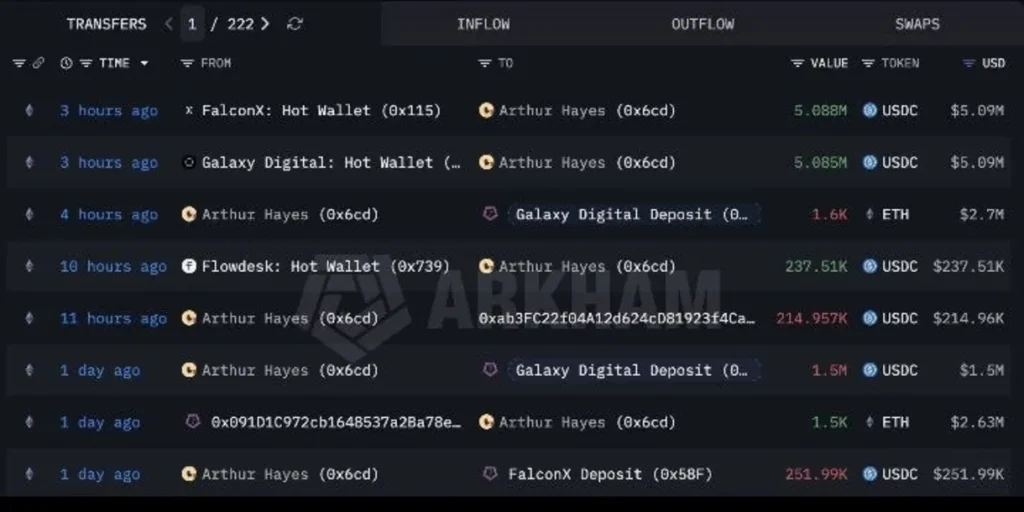
This was not a small, casual trade. It was a deliberate, structured unwind.
Hayes Bought High, Sold Low — But Is That the Whole Story?
The mechanics here are worth unpacking. Hayes is not a trader who makes careless mistakes at this scale.
Accepting a $606K loss on a short-term ETH position suggests one of two things: either the macro view that prompted the accumulation changed quickly and he exited to limit further downside, or this was a calculated hedge within a larger strategy that the on-chain data alone doesn’t fully reveal.
Neither interpretation is reassuring for short-term ETH bulls. When a trader of Hayes’ profile cuts a loss rather than holding through a dip, it tends to reflect genuine concern about near-term price direction.
As Hayes himself has written on managing losing positions:
“The market doesn’t care about your entry price. It only cares about what happens next. Holding a bad trade longer doesn’t make it a good trade — it just makes the loss larger.”
The Chart That Watched the Whole Thing Happen
Data pulled from CoinGecko on June 20, 2026 at approximately 13:30 UTC shows Ethereum trading at $1,727.33, up 2.8% over seven days.
But the weekly chart tells a more complicated story. ETH climbed from $1,650 on June 14 to a peak near $1,850 on June 16 — a sharp, confident move. Then the reversal came.
From June 17 onward, price dropped steadily, bottoming near $1,680 on June 19 — almost precisely where Hayes exited — before a modest recovery to current levels.
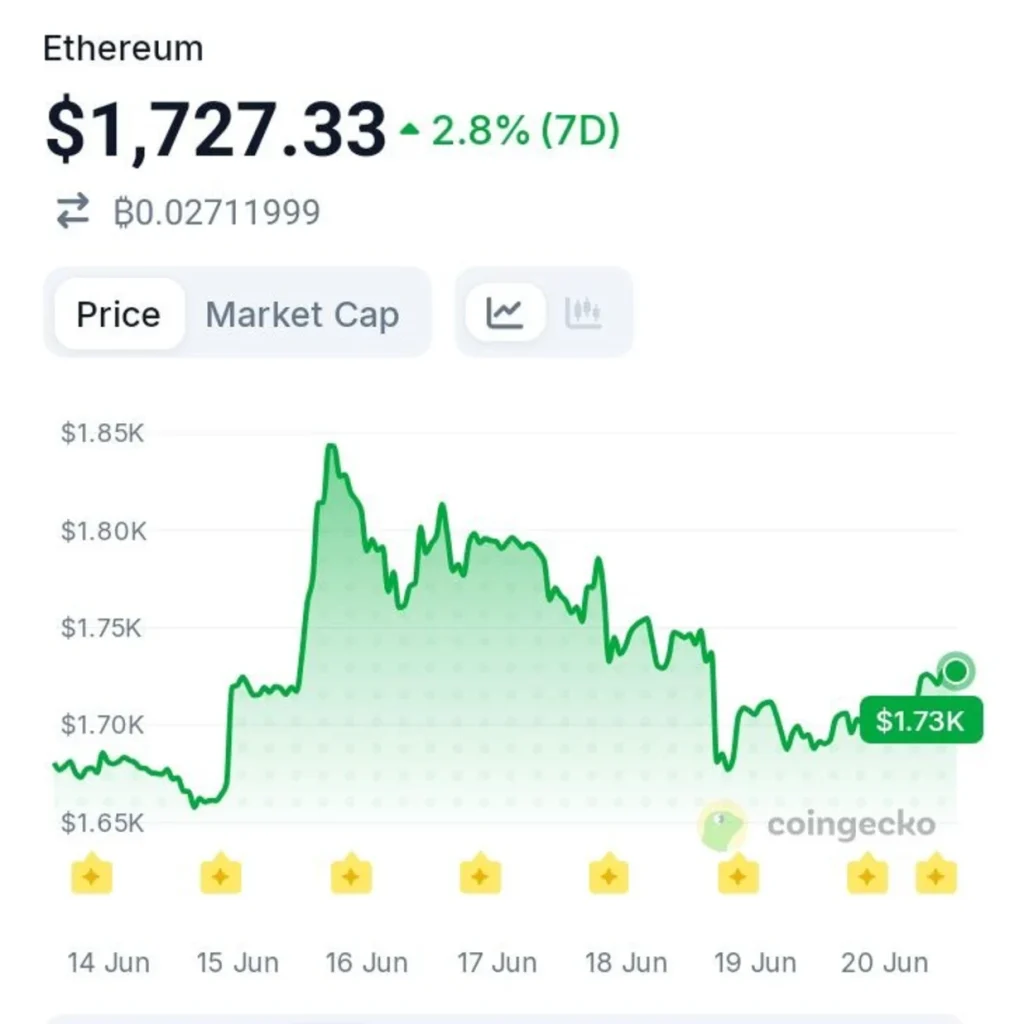
The chart is still technically in positive territory for the week, but the momentum has clearly shifted from bullish to cautious.
What Does This Mean for Ethereum?
Hayes selling into weakness rather than buying the dip is the detail that matters most here.
Ethereum has struggled to sustain rallies above $1,800 in recent weeks despite positive macro conditions and growing ETF inflow momentum.
The $1,700 level is now acting as a pivot — supportive enough to slow the decline, but not strong enough yet to invite fresh conviction buying from large players.
One high-profile exit doesn’t define a market. But when the exit comes with a six-figure loss and zero signs of re-accumulation in the transfer data, it raises a question worth sitting with:
If Arthur Hayes didn’t want to hold ETH at $1,690, what price does he need to see before he buys it back?
Disclaimer:
This article is for informational purposes only and does not constitute financial, investment, or trading advice. The views expressed are based on publicly available data, market observations, and the author’s interpretation at the time of writing. Cryptocurrency markets are highly volatile and unpredictable, and past performance or current technical setups do not guarantee future results. Readers should conduct their own research and consult with a qualified financial advisor before making any investment decisions. TechGaged does not accept liability for any losses incurred based on the information presented.
How do you rate this article?
Subscribe to our YouTube channel for crypto market insights and educational videos.






Join our Socials
Briefly, clearly and without noise – get the most important crypto news and market insights first.
Most Read Today
1
Bitcoin Reclaims $64,000: Next Key Breakout Level Identified
2Brighton Jones Discloses Nearly $2 Million in Spot Bitcoin ETF Holdings
3Bitcoin’s Biggest Holders Are Quietly Sending a Signal — What Comes Next?
4Why Most Blockchains Are Slower in Reality Than In Theory
5Bitcoin & Ethereum Today: Why Price Action Feels Uneasy
Latest





8
Also read
Similar stories you might like.

Crypto News
BitMine Makes Another Massive Ethereum Bet — What Is Tom Lee Seeing?
Azeez | 2026-08-11

Blockchain
Bullish: Go-Ethereum Client Update Lays Groundwork for Amsterdam Hardfork
TechGaged | 2026-07-29

Blockchain
Zcash Drops 5.91% to $510.16 Amid Broader Market Activity
TechGaged | 2026-07-22

Blockchain
Ethereum Developers Release v1.7.0-alpha.12 Specs; Here’s What to Know
TechGaged | 2026-07-08

Market
Bitwise Files Amended S-1 for Spot NEAR ETF, Eyes Approval
TechGaged | 2026-07-02

Crypto News
Which Blockchain Keeps Users Coming Back? The Data Reveals the Winner
Azeez | 2026-06-30

Crypto News
BlackRock Has Sold ETH for 7 Straight Days — Is Institutional Sentiment Changing?
Azeez | 2026-06-30

Crypto News
84% of Altcoins in ‘Total Underperformance’, Bitcoin Moving to $58K
Ana | 2026-06-30

Crypto News
Bitcoin Fails to Hold $60K, ETFs Continue Pressuring Market
Ana | 2026-06-29

Crypto News
A Massive Shift Is Taking Place Inside the Chainlink Network
Azeez | 2026-06-27